

Fiber packaging: moving into industrial production
For years, the question was always the same: can fiber replace plastic?
Today, for packaging manufacturers, the real question is different. Can fiber support large-scale production, with the volumes and line continuity industrial operations require, while fitting into existing plants without forcing a full redesign of the production setup?
Productivity: where trial ends and production begins
Once output reaches thousands of parts per shift, cycle time stops being just a technical metric and becomes a production constraint.
At that point, it is not enough for a material to simply perform. It has to deliver consistent quality and repeatability, without introducing variables that lead to scrap, instability and downtime.
In production, three very practical factors matter most:
- hourly output in terms of parts per hour and machine utilisation
- process stability with repeatable performance over long shifts and scrap kept under control
- plant compatibility including footprint, utilities and how easily the line can be replicated across different sites.
This is where many solutions begin to show their limits.
Wet molded fiber: a proven process, but harder to scale
Traditional wet-molding technologies rely on forming and drying in the presence of water. It is a well-established process, but as production volumes increase, its practical limits become more apparent:
- larger and more complex lines, with tanks, water handling, and sludge or recirculation management
- energy demand linked to the drying phase
- longer cycle times, which are difficult to reduce without affecting quality and scrap rates.
At lower volumes, or for high-value products, these trade-offs can be manageable. But in serial production, with large batches and continuous output, they become a real operational constraint.
Dry molded fiber: what changes when water is removed
Dry molding follows a different logic. The component is formed through heat and pressure, without the water-management stages typical of wet molding.
In terms of production, the difference is immediately clear:
- the line takes up less space
- integration into existing plants is easier
- replication across different facilities becomes more straightforward, with the same layout, the same parameters and fewer variables to control.
At this stage, the material becomes critical again, because not all fibers behave in the same way in dry molding.
Why the material must be designed for the process
Many fiber-based materials currently on the market were not developed to run efficiently and consistently in high-productivity dry-molding applications.
With this technology, composition alone is not enough. What matters is how the material responds to heat and pressure, and how well the formed part compacts and remains stable as it leaves the mold.
PulpForm was developed to meet exactly this needs.
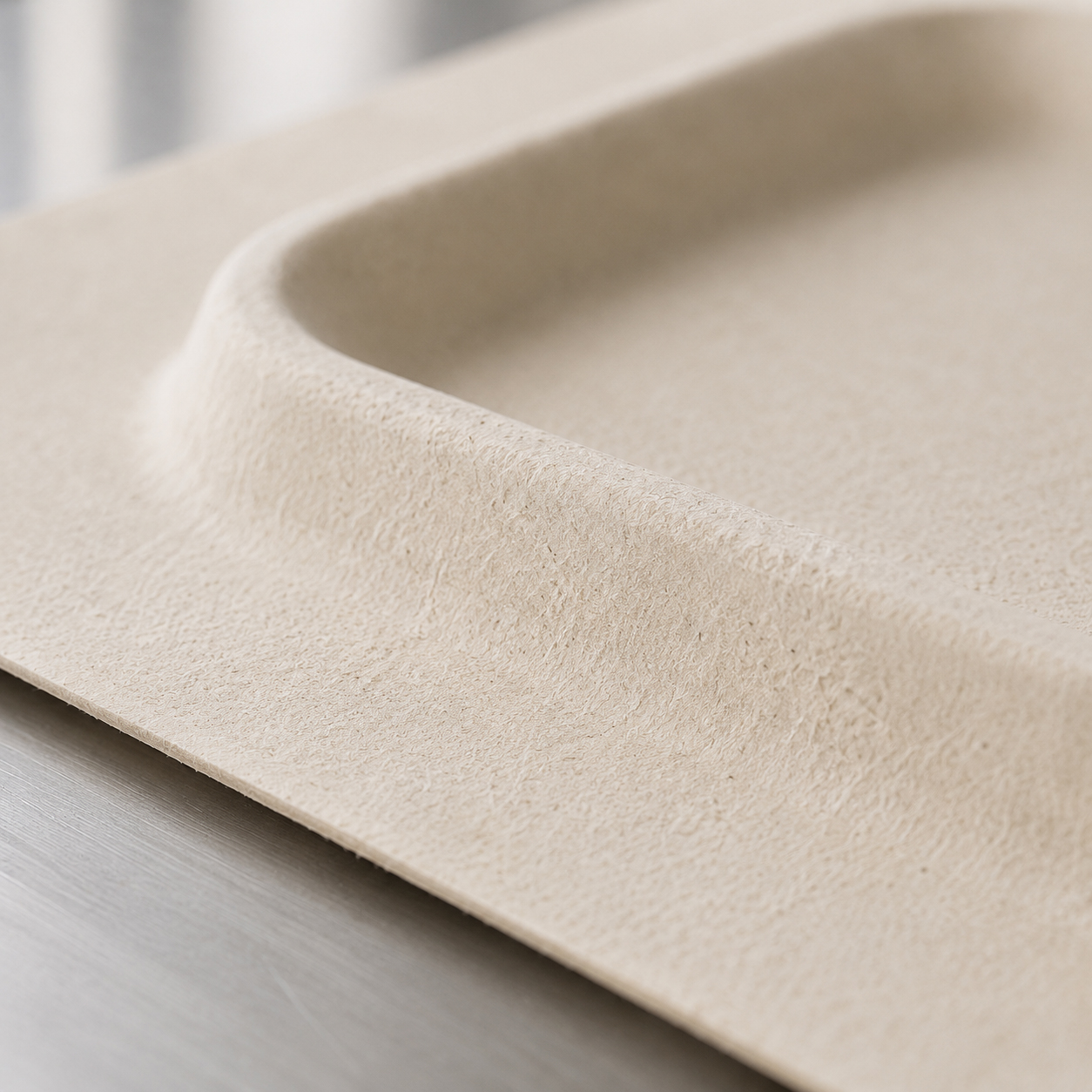
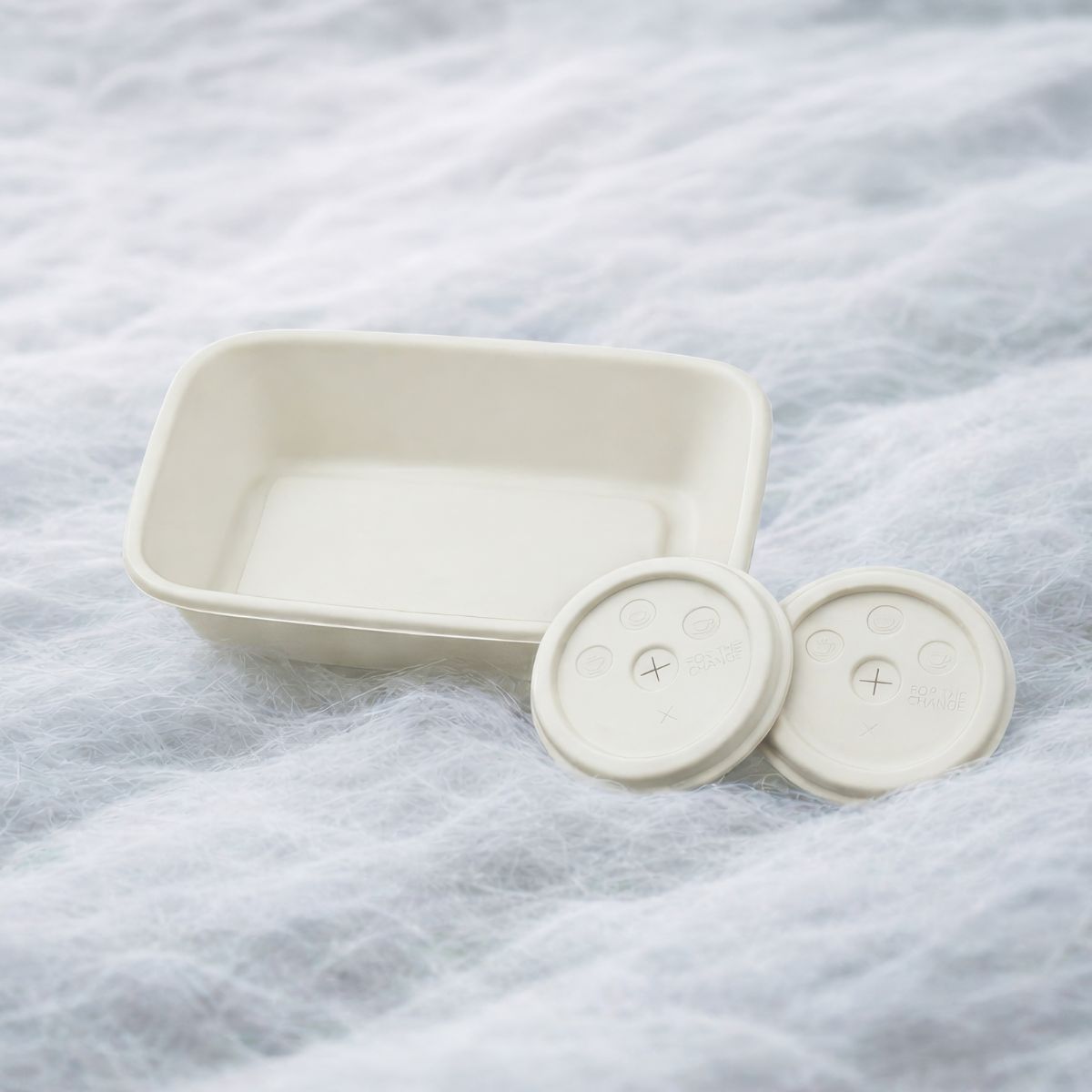
It is a compostable, cellulose-based airlaid material designed specifically for dry molding. The result is a more stable process window, with fewer line adjustments required.
With cycle times that can reach around 3.5 seconds per part, fiber starts to move closer to the pace required by modern packaging production.
Removing water also means reducing variables, footprint and operating complexity. Ramp-up becomes faster and more straightforward because there are fewer process variables to manage.
European regulation: from compliance to industrial reality
The key reference is the PPWR, which is pushing the sector beyond materials that are simply viable alternatives and towards solutions that can actually be adopted at industrial scale.
For packaging manufacturers, the criterion is practical.
A different material on its own is not enough. The solution must also be stable, repeatable and ready for production.
That is why the industry is increasingly looking for solutions that do more than replace one material with another. They must be adopted with continuity, with steady volumes, stable parameters and performance that can be verified over time.
The real selection criterion
For companies evaluating fiber, the choice is not only about the material itself. Above all, it is a production decision: which process can maintain consistent volumes, stable parameters and design flexibility when formats change?
If dry molding is the direction, then the material must be designed for that process.
PulpForm was developed with this in mind: an airlaid material engineered for dry thermoforming, to support continuous production with less scrap and fewer line stoppages.